 0
0
 0
0
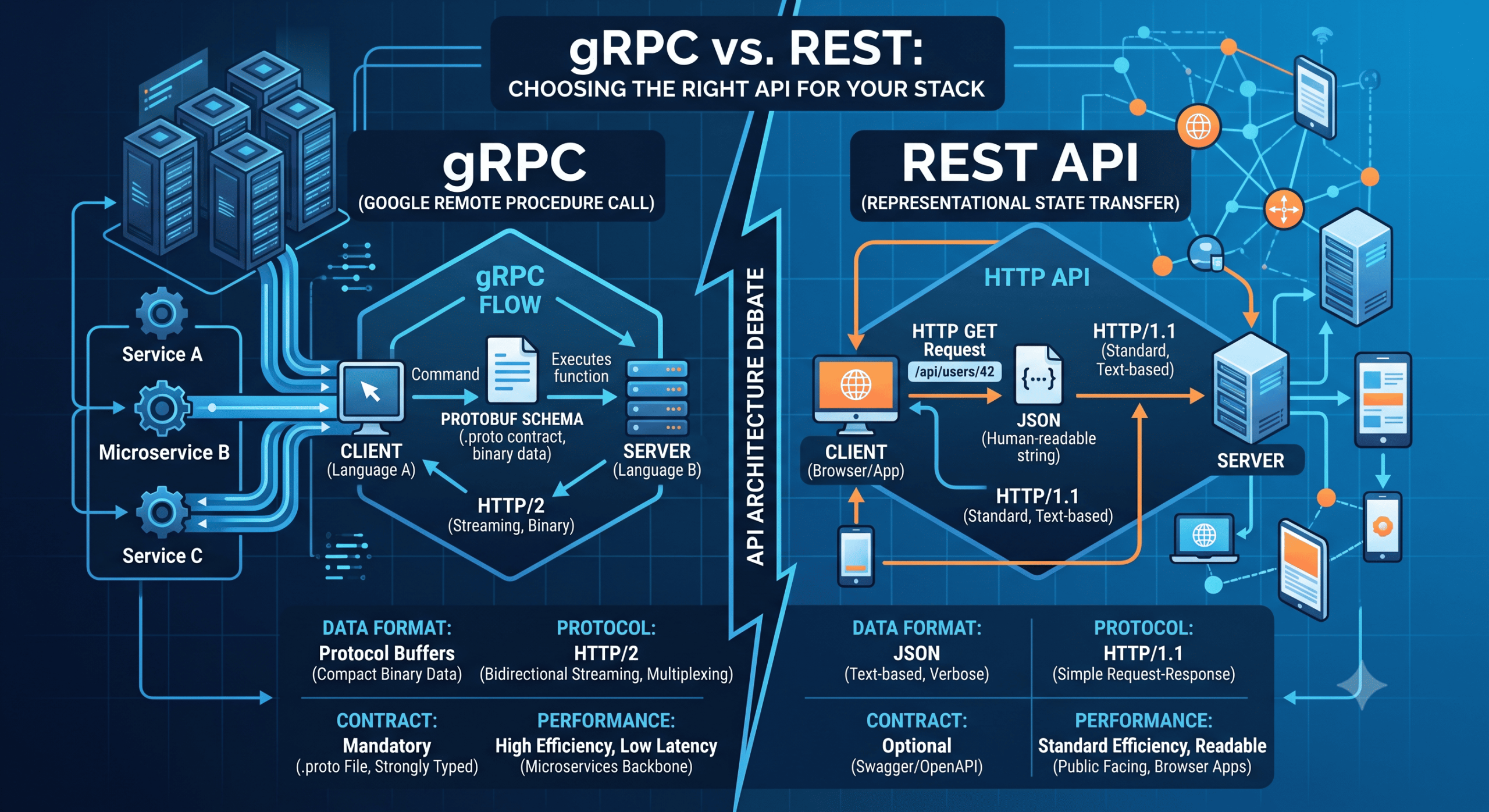
Don’t just follow the hype. Take a practical, no-nonsense look at what gRPC actually is, why it beats REST for internal microservices, and when you should stick to traditional JSON APIs.
Let’s face it: most “API protocol wars” are less about actual engineering and more about comfort zones. One team swears by REST because they can open Postman, shoot off a JSON payload, and read it like human beings. Another team pushes for gRPC because they want to build bleeding-edge microservices without the overhead of HTTP/1.1 string parsing.
But as engineering systems scale, you can’t just follow trends—you have to understand the architectural trade-offs.
Here is a practical, no-nonsense guide to what gRPC actually is, why it matters, and exactly how it stacks up against REST in modern software development.
What is gRPC, Anyway?
To understand gRPC (Google Remote Procedure Call), you have to look past the “web page” model of the internet.
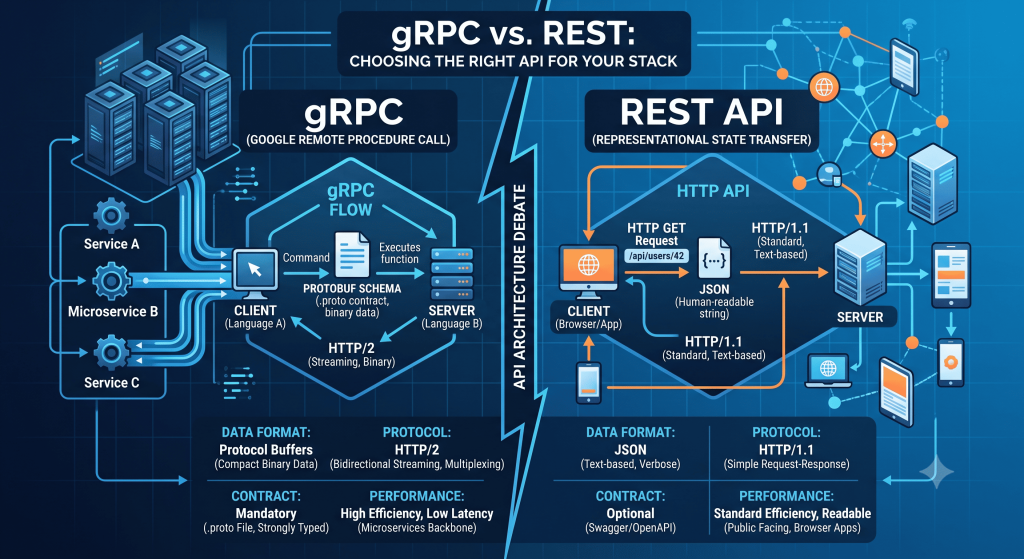
In a traditional REST API, you think in terms of resources and HTTP verbs: you send a GET request to /api/users/42 and expect a JSON payload back.
gRPC flips the script. It brings back the Remote Procedure Call (RPC) mental model. Instead of thinking about endpoints and URLs, you think in terms of functions. A client calls a method on a local stub object, and gRPC handles the magic of executing that function on a remote server as if it were running locally.
[ Client App ] –> ( Local Function Call )
|
(gRPC Stub) — [ Protobuf over HTTP/2 ] –> (gRPC Server) — Executes Code
Under the hood, gRPC relies on two core pillars that make it brutally efficient:
- Protocol Buffers (Protobuf): Instead of text-heavy JSON or XML, gRPC uses Protobuf—a binary serialization format developed by Google. You define your data structures and services in a strict
.protofile, and a compiler generates strongly-typed client/server code in whatever language you’re writing. - HTTP/2 Transport: Unlike traditional REST which typically relies on HTTP/1.1, gRPC runs exclusively on HTTP/2. This unlocks features like true bidirectional streaming and multiplexing (sending multiple requests over a single TCP connection simultaneously).
Why gRPC? (The Real-World Benefits)
If REST works perfectly fine for your frontend, why bother introducing gRPC to your stack? It boils down to three massive advantages:
1. Speed and Low Latency
JSON is great because humans can read it. But computers hate parsing strings. Protobuf serializes data into a compact binary format. On the wire, a Protobuf message is typically 3x to 10x smaller than its JSON equivalent. Combined with HTTP/2’s binary framing and header compression, gRPC drastically cuts down on p99 latency and CPU overhead, making it incredibly fast.
2. Strictly Enforced Contracts
How many times has a backend engineer changed a field from an integer to a string, breaking the frontend or a downstream microservice? With gRPC, the .proto file is your single source of truth.
// A typical service definition contract
syntax = "proto3";

message UserRequest {
  int32 user_id = 1;
}

message UserResponse {
  string name = 1;
  string email = 2;
}

service UserService {
  rpc GetUserProfile (UserRequest) returns (UserResponse);
}
Because the client and server code are auto-generated from this exact file, you get compile-time safety across different languages (e.g., a Go backend talking seamlessly to a Java service). If the contract doesn’t match, the code won’t compile.
3. First-Class Streaming
REST treats streaming as an afterthought (relying on WebSockets or Server-Sent Events). gRPC supports four native communication streams out of the box:
- Unary: Standard request-response (like REST).
- Server Streaming: One request, a continuous stream of responses (great for live tickers).
- Client Streaming: A stream of requests, one final response (great for log uploads).
- Bidirectional Streaming: Both client and server talking to each other simultaneously on a single open connection (perfect for real-time chat or collaborative tools).
gRPC vs. REST: The Core Differences
To keep it simple, here is how the two match up side-by-side:
| Feature | REST API | gRPC |
| Data Format | JSON, XML (Text-based) | Protocol Buffers (Binary) |
| Protocol | Usually HTTP/1.1 | HTTP/2 Exclusively |
| Streaming | Unary (Request-Response) | Unary, Client, Server, Bidirectional |
| Contract | Optional (OpenAPI/Swagger) | Mandatory (.proto file) |
| Readability | Human-readable | Binary (Requires tooling to inspect) |
| Browser Support | Universal & Native | Limited (Requires a proxy like gRPC-Web) |
The Catch: Where gRPC Struggles
No architecture is a silver bullet. If you deploy gRPC everywhere, you’re going to hit a few walls:
- The Browser Problem: Web browsers don’t fully expose the low-level HTTP/2 features that gRPC requires. To use gRPC on a web frontend, you have to use
gRPC-Weband run a proxy (like Envoy) to translate the traffic. It’s doable, but it adds architectural weight. - Debugging Friction: You can’t just run a quick
curlcommand or look at the Network tab in Chrome DevTools to see a gRPC payload. Because it’s binary, you need specialized tools likegrpcurlor BloomRPC to figure out what’s going wrong. - Tight Coupling: While the strict schema is a feature, it’s also a constraint. If your API needs to change wildly and frequently on an early-stage product, managing the
.protoevolution lifecycle can introduce friction you don’t need yet.
The Verdict: Which One Should You Use?
Don’t treat this as an “either-or” framework war. Most modern high-scale architectures use a hybrid approach, picking the right tool for the specific boundary:
Outside World → Use REST (or GraphQL): For public-facing APIs, third-party integrations, and direct browser clients, stick to REST. The universality, ease of onboarding, and human-readability make it the undisputed king of the outer edge.
Inside World → Use gRPC: For internal service-to-service communication inside a microservices cluster, high-throughput data pipelines, real-time streaming, or latency-sensitive workloads, use gRPC.
Start simple. If your REST API handles your current traffic without breaking a sweat, don’t over-engineer. But the moment your internal services start choking on heavy JSON payloads and TCP connection bottlenecks, it’s time to build a gRPC fast lane.


About Author
